
£58.38
On Hold
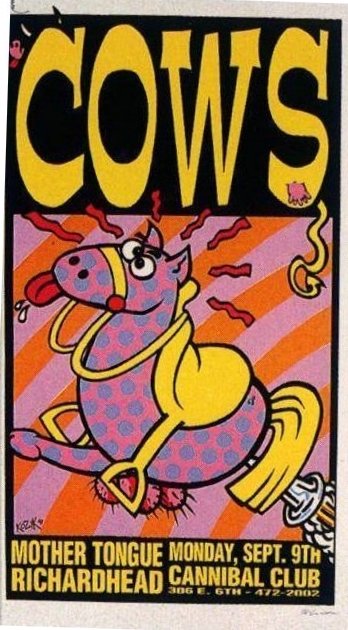
COWS Cannibal '91 KOZIK Signed Silkscreen POSTER Rare
Only 1 available
Details
Shipping: USPS calculated - check
Condition: Used
*The store has not been updated recently. You may want to contact the merchant to confirm the availability of the product.
The CowsMother TongueRichard HeadCannibal Club Austin, Texas199114.5" x 28"Screen Print Concert PosterFrank Kozik Signed ArtExcellent to Near Mint condition, 9 of 10 or better, stored rolled and well protected since the original 90's acquisitionRARE!This is an original single sheet printed paper poster advertisement (A.K.A. street art, handbill, flyer or print) for a concert performance gig by professional musicians at a music venue. Guaranteed original and authentic, printed prior to, and in conjunction with the promotion of the event. A Sound Deal does not sell poster re-prints, scans or duplications of any kind, so please don't ask. Add me to your favorites for red hot sales bulletins and sneak previews of upcoming products. Combine Items to Save $$$!!!Click here to check the store for more!Biographyby John Dougan - Longtime denizens of the Minneapolis rock scene, the Cows are one of America's great degenerate punk rock bands. Starting off as near-total incompetents, they have become more technically polished musicians during the '90s, but their white-hot noise rock has not been tamed one bit. In many ways, the Cows remain as gloriously messy, primitive, and exciting as they were the day they started. Formed in the mid-'80s by idiosyncratic lead singer Shannon Selberg, the Cows appropriated the hardcore guitar blur that characterized fellow-Twin Citians Hüsker Dü, but stripped away any and all concessions to melodies, hooks, riffs -- essentially anything that remotely resembled pop. What they offered was a blazing wall of distortion that was punk rock at its crudest; a feral racket that sounded as if the guitars were being played with metal files. Above the din was Selberg, free-associating surreal vignettes about, well, God knows what, but his squealing, shrieking, and general lunacy provided the bizarre, often engaging, focus. He plays trumpet, too -- well, not so much plays as blasts a note or two when he's tired of ranting. After the release of their first album in 1987, the Cows were roundly derided as a talentless, tasteless joke (a charge that would be leveled a few years later against Babes in Toyland). However, they've stayed true to their anti-commercial stance and punk roots, releasing a handful of weird, loud, gleefully unhinged records that seem to get better (i.e., more focused and less obtuse) and retain the band's devotion to mania."In the '60s posters were adjunt to the scene, and not for like, basic information. Punk posters were all about info, as most shows were in sh*tholes with no ad money. When I came on the scene there was a new context that made my work desirable." - Frank Kozik -Art ofModern Rock aomr.comAustin Chronicle I'm Sorry, Yogi By Raoul HernandezSEPTEMBER 15, 1997: Like it or not, Frank Kozik is legend. If he never draws another red devil b*tch with big t!ts announcing a Godbullies/Hole show at Club Soda (wherever that is), or a zombied-out Nazi clown saluting a spoken-word event at the Dobie Cinema, he'd still be legend. And legend has it that Kozik is a prick; a two-bit punk with bad manners. At least that's what some in the local music community will rant and rave given the right opportunity, and when were they ever spiteful of success? Success never equaled selling out, right? No, 'course not. Not in Austin. So, maybe they didn't like his posters. My favorite has to be the Sebadoh poster in which Boo-Boo Bear, his teddy-bear sincerity lit by the moon, is looking up at a figure nailed on a cross. In his book The Posters & Art of Frank Kozik, the poster artist has a three-word analysis of the image: "I'm sorry, Yogi..." Remember that cartoon voice? Why, why that's sacrilege! Kozik has raped our collective cartoon consciousness. And what about that Butthole Surfers/Bad Livers New Year's Eve poster in which bondage babe Betty Rubble is frenching Wilma Flintstone (also a mural down at your friendly, neighborhood punk club, Emo's)? Why it's perverted! Depraved! Bad taste, even! And what's with all the Nazi symbolism (war imagery is a Kozik staple), and all those portraits of charming Charlie Manson; The Jesus Lizard/Jon Spencer Blues Explosion posters featuring Walter Keane-ish renditions of Adolf Hitler and Manson with captions that read "The Father" and "The Son," respectively. Nice. And Kennedy being blown away or Lee Harvey Oswald singing for Helmet and L7 (Donita Sparks undoubtedly loved that one). Beheadings, butchered bunnies (lots of other dead rodents), beautiful sunshine children with prosthetic limbs. What would mom say? "Some people think it's the greatest f*cking pop art deconstructionist cultural trip in the world, " says Kozik frankly -- Frank is always frank. "Other people say it's pure f*cking bullsh*t." Whatever the image, after flipping through 96 glossy, quality bond-paper pages of Kozik's poster art (much of it as irretrievable as that 100-year-old staple embedded in a barren phone pool), one is reminded, at the very least, of Andy Warhol and what he did with found media images. Gasp. Is Kozik headed for some city's museum of modern art (in addition to the 14 art openings he had last year in places like Tokyo, Vienna, and Stockholm)? Judging by the 35-year-old's San Francisco offices, yes. "I personally don't think I'm very good," says Kozik, leaning back in his chair as the August afternoon blows fresh, cool marina air in through an entire wall of third-story windows. "I like to do it. I think I'm getting better, and I'm working on a second book right now, which, when it comes out, you'll be able to see a progression." Oh, you can see the progression alright; you can see it through the billowing white drapes. It's looks a lot like a perfect view of the San Francisco Bay. Last time yours truly viewed Kozik's surroundings, it was in Austin, from the inside of the huge, haunted mansion-looking barn that the poster artist lived in down on 12th Street. At the time, in the fall of '93, Ken Lieck and myself were mooching Dazed and Confused posters off of Kozik. He wasn't really paying us much mind, pulling out posters and grumbling about shaking the dust of this cruddy little town off his boots. His poster empire was already well into its ascendancy, and by the following spring, one could almost hear his rueful, "So long, sucker" as he bolted Austin for San Francisco. Not that he didn't put in his time here -- try 13 long years. Kozik had arrived in Austin in 1980, as a member of the Air Force stationed at Bergstrom. Born in Spain to an aristocratic mother and an American military man, Kozik moved to the United States when he was 15, quickly growing disenchanted with the suburban desert that is California's capital, Sacramento. He dropped out of high school, joined the United States armed forces, and wound up in Texas. "When I came over to the states in '76," says Kozik, who speaks Spanish fluently in accordance with his early upbringing, "it was cool, because I went from this Victorian world to one where I could have a car, I could smoke pot, I and I could listen to heavy metal music -- the exact reverse of everything that my life had been in Spain. The problem was those people were dipsh*ts. I never really got along with any of that crowd. Punk rock was the perfect fusion, where it was completely weird and chaotic and promoted random acts of drug use." In the early Eighties, there were few places better for misfit punk kids than Austin, a place crawling with weird and chaotic -- not to mention random acts of drug abuse. Whereas punk emporium Raul's was closing down, Club Foot had just opened, and Kozik quickly found a home within the scene. "The scene was really crazy, but it had this intellectual tint to it, because it was older people doing it -- college people, or just weird, liberal freak people," explains Kozik. "There were a lot of gays in the scene, because it was all mixed up at first. You'd go to the club and there would be like gays, New Wave people, leftover Cosmic Cowboy guys, these weird punk people. It was kinda like it was a big joke. "But that was the initial attraction -- I fit in. I could give vent to my intelligent side, because a lot of the music was intellectual in its own weird way. You had to get it. At the same time, I was young and stupid and wanted to get stoned, and f*ck, and be physically retarded, so it was like perfect." Since he didn't play any instrument, yet wanted to hang around the scene "and be cool," Kozik fell in with a couple of guys doing "your basic mail-art street Xerox thing," according to the intro to his book. By 1985, this had developed naturally enough into the art of Xeroxed hand-bills for such Club Foot acts as the Butthole Surfers and Scratch Acid. When Club Foot closed and the Cave Club opened, Kozik got a job there as doorman, and fell in with the mastermind behind both clubs and a man many longtime Austin scenesters give credit to as the godfather of modern-era poster art, Brad First. "Brad was really influential," says Kozik, "because he totally encouraged it. He paid for printing, and sometimes he even paid me. And that was like a completely novel experience. So, it really focused it. That's why there's so many posters for his clubs, because that was the focal point. He gave me an outlet and I got to attach myself to the music really firmly. He did pretty good for a while there; bands started touring through, and they'd take the posters to another city, and then someone from another city would call and go, `Hey man, will you do a poster for our show in Houston?' It sort of grew like that." Working out of a studio space that included first generation poster artists like Micael Priest and Guy Juke, it wasn't long before a poster collector on a reconnaissance mission from L.A. came sniffing around the place looking for poster art collectibles. Kozik gave him an armful of his work and before he knew it, some Hollywood art cartel had given him $10,000 to set up his own jerry-rigged silkscreen p


