
£29.33
Add to Cart
Bo Diddley - Bo Diddley's Greatest Hits GRT Checker 2989 8-track tape
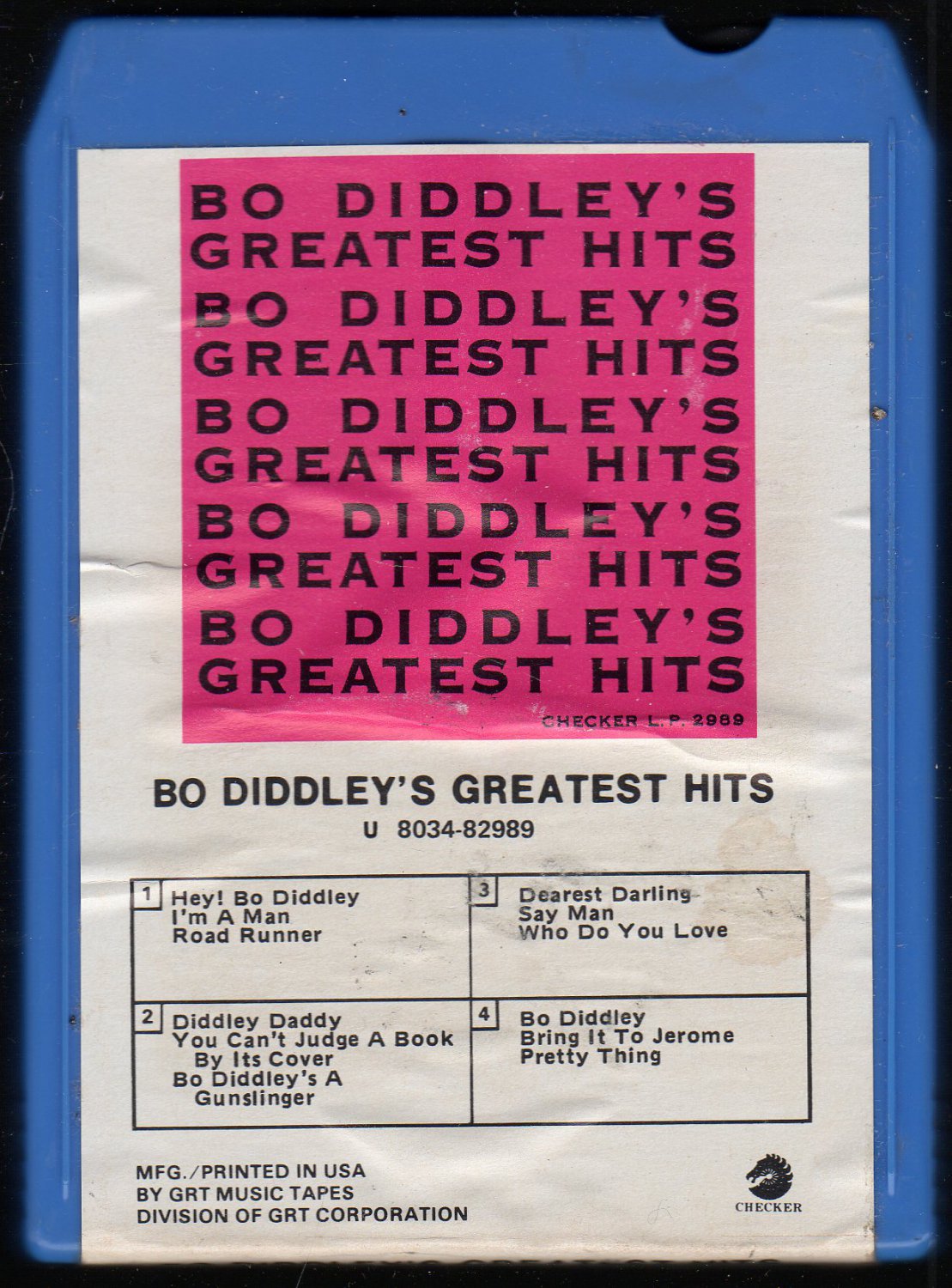


Ellas Otha Bates (December 30, 1928 – June 2, 2008), known by his stage name Bo Diddley, was an American rhythm and blues vocalist, guitarist, songwriter (usually as Ellas McDaniel), and inventor. He was also known as "The Originator" because of his key role in the transition from the blues to rock & roll, influencing a host of acts including Buddy Holly, Jimi Hendrix, The Rolling Stones, The Velvet Underground, The Who, The Clash, The Yardbirds, and Eric Clapton. He introduced more insistent, driving rhythms and a hard-edged guitar sound on a wide-ranging catalog of songs. Accordingly, he was inducted into the Rock and Roll Hall of Fame and received Lifetime Achievement Awards from the Rhythm and Blues Foundation and a Grammy Award from the National Academy of Recording Arts and Sciences. He was known in particular for his technical innovations, including his trademark rectangular guitar.
Born in McComb, Mississippi, as Ellas Otha Bates, he was adopted and raised by his mother's cousin, Gussie McDaniel, whose surname he assumed, becoming Ellas McDaniel. In 1934, the McDaniel family moved to the largely black South Side area of Chicago, where the young man dropped the name Otha and became known as Ellas McDaniel, until his musical ambitions demanded that he take on a more catchy identity. In Chicago, he was an active member of his local Ebenezer Baptist Church, where he studied the trombone and the violin, becoming proficient enough on the latter for the musical director to invite him to join the orchestra, with which he performed until the age of 18. He was more impressed, however, by the pulsating, rhythmic music he heard at a local Pentecostal Church, as well as an interest in the guitar.
Inspired by a concert where he saw John Lee Hooker perform, he supplemented his work as a carpenter and mechanic with a developing career playing on street corners with friends, including Jerome Green (c. 1934–1973), in a band called The Hipsters (later The Langley Avenue Jive Cats). During the summer of 1943–44, he played for tips at the Maxwell Street market in a band with Earl Hooker. By 1951 he was playing on the street with backing from Roosevelt Jackson (on washtub bass) and Jody Williams (whom he had taught to play the guitar). Williams later played lead guitar on "Who Do You Love?" (1956). In 1951 he landed a regular spot at the 708 Club on Chicago's South Side, with a repertoire influenced by Louis Jordan, John Lee Hooker, and Muddy Waters.
In late 1954, he teamed up with harmonica player Billy Boy Arnold, drummer Clifton James, and bass player Roosevelt Jackson, and recorded demos of "I'm A Man" and "Bo Diddley". They re-recorded the songs at Chess Studios with a backing ensemble comprising Otis Spann (piano), Lester Davenport (harmonica), Frank Kirkland (drums), and Jerome Green (maracas). The record was released in March 1955, and the A-side, "Bo Diddley", became a #1 R&B hit.
McDaniel adopted the stage name "Bo Diddley". The origin of the name is somewhat unclear, as several differing stories and claims exist. Diddley claims that his peers gave him the nickname, which he first suspected to be an insult. Bo Diddley himself said that the name first belonged to a singer his adoptive mother was familiar with, while harmonicist Billy Boy Arnold once said in an interview that it was originally the name of a local comedian that Leonard Chess borrowed for the song title and artist name for Bo Diddley's first single.
A "diddley bow" is a typically homemade American string instrument of African origin, probably developed from instruments found on the coast of west Africa.
Over the decades, Bo Diddley's venues ranged from intimate clubs to stadiums. On March 25, 1972, he played with The Grateful Dead at the Academy of Music in New York City. The Grateful Dead released part of this concert as Volume 30 of the band's Dick's Picks concert album series. Also in the early 1970s, the soundtrack for the ground-breaking animated film Fritz The Cat contained his song "Bo Diddley", in which a crow idly finger-pops along to the track.
Bo Diddley spent many years in New Mexico, living in Los Lunas, New Mexico from 1971 to 1978 while continuing his musical career. He served for two and a half years as Deputy Sheriff in the Valencia County Citizens' Patrol; during that time he personally purchased and donated three highway patrol pursuit cars. In the late 1970s, Diddley left Los Lunas and moved to Hawthorne, Florida where he lived on a large estate in a custom made log-cabin home, which he helped to build. For the remainder of his life he spent time between Albuquerque, New Mexico and Florida, living the last 13 years of his life in Archer, Florida, a small farming town near Gainesville.
He appeared as an opening act for The Clash in their 1979 US tour; in Legends of Guitar (filmed live in Spain, 1991) with B.B. King, Les Paul, Albert Collins, George Benson, among others, and joined The Rolling Stones as a guest on their 1994 concert broadcast of Voodoo Lounge, performing "Who Do You Love?" with the band. Sheryl Crow and Robert Cray also appeared on the pay-per-view special.
Bo Diddley died on June 2, 2008 of heart failure at his home in Archer, Florida. Garry Mitchell, a grandson of Diddley and one of more than 35 family members at the musician's home when he died at 1:45 a.m. EDT (05:45 GMT), said his death was not unexpected. "There was a gospel song that was sung (at his bedside) and (when it was done) he said 'wow' with a thumbs up," Mitchell told Reuters, when asked to describe the scene at Diddley's deathbed. "The song was 'Walk Around Heaven' and in his last words he said 'I'm going to heaven.'"
His funeral, a four-hour "homegoing" service, took place on June 7, 2008, at Showers of Blessings Church in Gainesville, Florida and kept in tune with the vibrant spirit of Bo Diddley's life and career. The many in attendance chanted "Hey Bo Diddley" as a gospel band played the legend's music. A number of notable musicians sent flowers, including: George Thorogood, Tom Petty, and Jerry Lee Lewis. Little Richard, who had been asking his audiences to pray for Bo Diddley throughout his illness, had to fulfill concert commitments in Westbury and New York City the weekend of the funeral. He took time to remember Bo Diddley, his friend of a half-century, performing his namesake tune in his honor.
After the funeral service, a tribute concert was held at the Martin Luther King Center, also in Gainesville, and featured performances by his son and daughter, Anthony McDaniel and Evelyn Kelly, long-time background vocalist Gloria Jolivet, co-producer Scott "Skyntyte" Free, Diddley's touring band, The Debby Hastings Band, and guest artist Eric Burdon.
In the days following his death, tributes were paid to him by then-President George W. Bush, the United States House of Representatives, and an uncounted number of musicians and performers, including Eric Burdon, Elvis Costello, Ronnie Hawkins, Mick Jagger, B. B. King, Tom Petty, Robert Plant, Bonnie Raitt, George Thorogood, Robert Randolph and the Family Band, the Black Lips and Ronnie Wood. He was posthumously awarded a Doctor of Fine Arts degree by the University of Florida for his influence on American popular music and in its "People in America" radio series about influential people in American history, the Voice of America radio service paid tribute to him, describing how "his influence was so widespread that it is hard to imagine what rock and roll would have sounded like without him." Mick Jagger stated that "he was a wonderful, original musician who was an enormous force in music and was a big influence on The Rolling Stones. He was very generous to us in our early years and we learned a lot from him." Jagger also praised the late star as a one of a kind musician, adding, "We will never see his like again. As his bass player Debby Hastings said: he was the rock that the roll was built on."
The documentary film Cheat You Fair: The Story of Maxwell Street by director Phil Ranstrom features Bo Diddley's last on-camera interview.
In November 2009 the guitar used by Diddley in his last-ever stage performance sold for $60,000 at auction.
Retrieved from
http://en.wikipedia.org/wiki/Bo_Diddley
Comes with foil splice, pads and a 7-day money back guarantee from 8tracksRBack.
Born in McComb, Mississippi, as Ellas Otha Bates, he was adopted and raised by his mother's cousin, Gussie McDaniel, whose surname he assumed, becoming Ellas McDaniel. In 1934, the McDaniel family moved to the largely black South Side area of Chicago, where the young man dropped the name Otha and became known as Ellas McDaniel, until his musical ambitions demanded that he take on a more catchy identity. In Chicago, he was an active member of his local Ebenezer Baptist Church, where he studied the trombone and the violin, becoming proficient enough on the latter for the musical director to invite him to join the orchestra, with which he performed until the age of 18. He was more impressed, however, by the pulsating, rhythmic music he heard at a local Pentecostal Church, as well as an interest in the guitar.
Inspired by a concert where he saw John Lee Hooker perform, he supplemented his work as a carpenter and mechanic with a developing career playing on street corners with friends, including Jerome Green (c. 1934–1973), in a band called The Hipsters (later The Langley Avenue Jive Cats). During the summer of 1943–44, he played for tips at the Maxwell Street market in a band with Earl Hooker. By 1951 he was playing on the street with backing from Roosevelt Jackson (on washtub bass) and Jody Williams (whom he had taught to play the guitar). Williams later played lead guitar on "Who Do You Love?" (1956). In 1951 he landed a regular spot at the 708 Club on Chicago's South Side, with a repertoire influenced by Louis Jordan, John Lee Hooker, and Muddy Waters.
In late 1954, he teamed up with harmonica player Billy Boy Arnold, drummer Clifton James, and bass player Roosevelt Jackson, and recorded demos of "I'm A Man" and "Bo Diddley". They re-recorded the songs at Chess Studios with a backing ensemble comprising Otis Spann (piano), Lester Davenport (harmonica), Frank Kirkland (drums), and Jerome Green (maracas). The record was released in March 1955, and the A-side, "Bo Diddley", became a #1 R&B hit.
McDaniel adopted the stage name "Bo Diddley". The origin of the name is somewhat unclear, as several differing stories and claims exist. Diddley claims that his peers gave him the nickname, which he first suspected to be an insult. Bo Diddley himself said that the name first belonged to a singer his adoptive mother was familiar with, while harmonicist Billy Boy Arnold once said in an interview that it was originally the name of a local comedian that Leonard Chess borrowed for the song title and artist name for Bo Diddley's first single.
A "diddley bow" is a typically homemade American string instrument of African origin, probably developed from instruments found on the coast of west Africa.
Over the decades, Bo Diddley's venues ranged from intimate clubs to stadiums. On March 25, 1972, he played with The Grateful Dead at the Academy of Music in New York City. The Grateful Dead released part of this concert as Volume 30 of the band's Dick's Picks concert album series. Also in the early 1970s, the soundtrack for the ground-breaking animated film Fritz The Cat contained his song "Bo Diddley", in which a crow idly finger-pops along to the track.
Bo Diddley spent many years in New Mexico, living in Los Lunas, New Mexico from 1971 to 1978 while continuing his musical career. He served for two and a half years as Deputy Sheriff in the Valencia County Citizens' Patrol; during that time he personally purchased and donated three highway patrol pursuit cars. In the late 1970s, Diddley left Los Lunas and moved to Hawthorne, Florida where he lived on a large estate in a custom made log-cabin home, which he helped to build. For the remainder of his life he spent time between Albuquerque, New Mexico and Florida, living the last 13 years of his life in Archer, Florida, a small farming town near Gainesville.
He appeared as an opening act for The Clash in their 1979 US tour; in Legends of Guitar (filmed live in Spain, 1991) with B.B. King, Les Paul, Albert Collins, George Benson, among others, and joined The Rolling Stones as a guest on their 1994 concert broadcast of Voodoo Lounge, performing "Who Do You Love?" with the band. Sheryl Crow and Robert Cray also appeared on the pay-per-view special.
Bo Diddley died on June 2, 2008 of heart failure at his home in Archer, Florida. Garry Mitchell, a grandson of Diddley and one of more than 35 family members at the musician's home when he died at 1:45 a.m. EDT (05:45 GMT), said his death was not unexpected. "There was a gospel song that was sung (at his bedside) and (when it was done) he said 'wow' with a thumbs up," Mitchell told Reuters, when asked to describe the scene at Diddley's deathbed. "The song was 'Walk Around Heaven' and in his last words he said 'I'm going to heaven.'"
His funeral, a four-hour "homegoing" service, took place on June 7, 2008, at Showers of Blessings Church in Gainesville, Florida and kept in tune with the vibrant spirit of Bo Diddley's life and career. The many in attendance chanted "Hey Bo Diddley" as a gospel band played the legend's music. A number of notable musicians sent flowers, including: George Thorogood, Tom Petty, and Jerry Lee Lewis. Little Richard, who had been asking his audiences to pray for Bo Diddley throughout his illness, had to fulfill concert commitments in Westbury and New York City the weekend of the funeral. He took time to remember Bo Diddley, his friend of a half-century, performing his namesake tune in his honor.
After the funeral service, a tribute concert was held at the Martin Luther King Center, also in Gainesville, and featured performances by his son and daughter, Anthony McDaniel and Evelyn Kelly, long-time background vocalist Gloria Jolivet, co-producer Scott "Skyntyte" Free, Diddley's touring band, The Debby Hastings Band, and guest artist Eric Burdon.
In the days following his death, tributes were paid to him by then-President George W. Bush, the United States House of Representatives, and an uncounted number of musicians and performers, including Eric Burdon, Elvis Costello, Ronnie Hawkins, Mick Jagger, B. B. King, Tom Petty, Robert Plant, Bonnie Raitt, George Thorogood, Robert Randolph and the Family Band, the Black Lips and Ronnie Wood. He was posthumously awarded a Doctor of Fine Arts degree by the University of Florida for his influence on American popular music and in its "People in America" radio series about influential people in American history, the Voice of America radio service paid tribute to him, describing how "his influence was so widespread that it is hard to imagine what rock and roll would have sounded like without him." Mick Jagger stated that "he was a wonderful, original musician who was an enormous force in music and was a big influence on The Rolling Stones. He was very generous to us in our early years and we learned a lot from him." Jagger also praised the late star as a one of a kind musician, adding, "We will never see his like again. As his bass player Debby Hastings said: he was the rock that the roll was built on."
The documentary film Cheat You Fair: The Story of Maxwell Street by director Phil Ranstrom features Bo Diddley's last on-camera interview.
In November 2009 the guitar used by Diddley in his last-ever stage performance sold for $60,000 at auction.
Retrieved from
http://en.wikipedia.org/wiki/Bo_Diddley
Comes with foil splice, pads and a 7-day money back guarantee from 8tracksRBack.


