
£11.43
On Hold
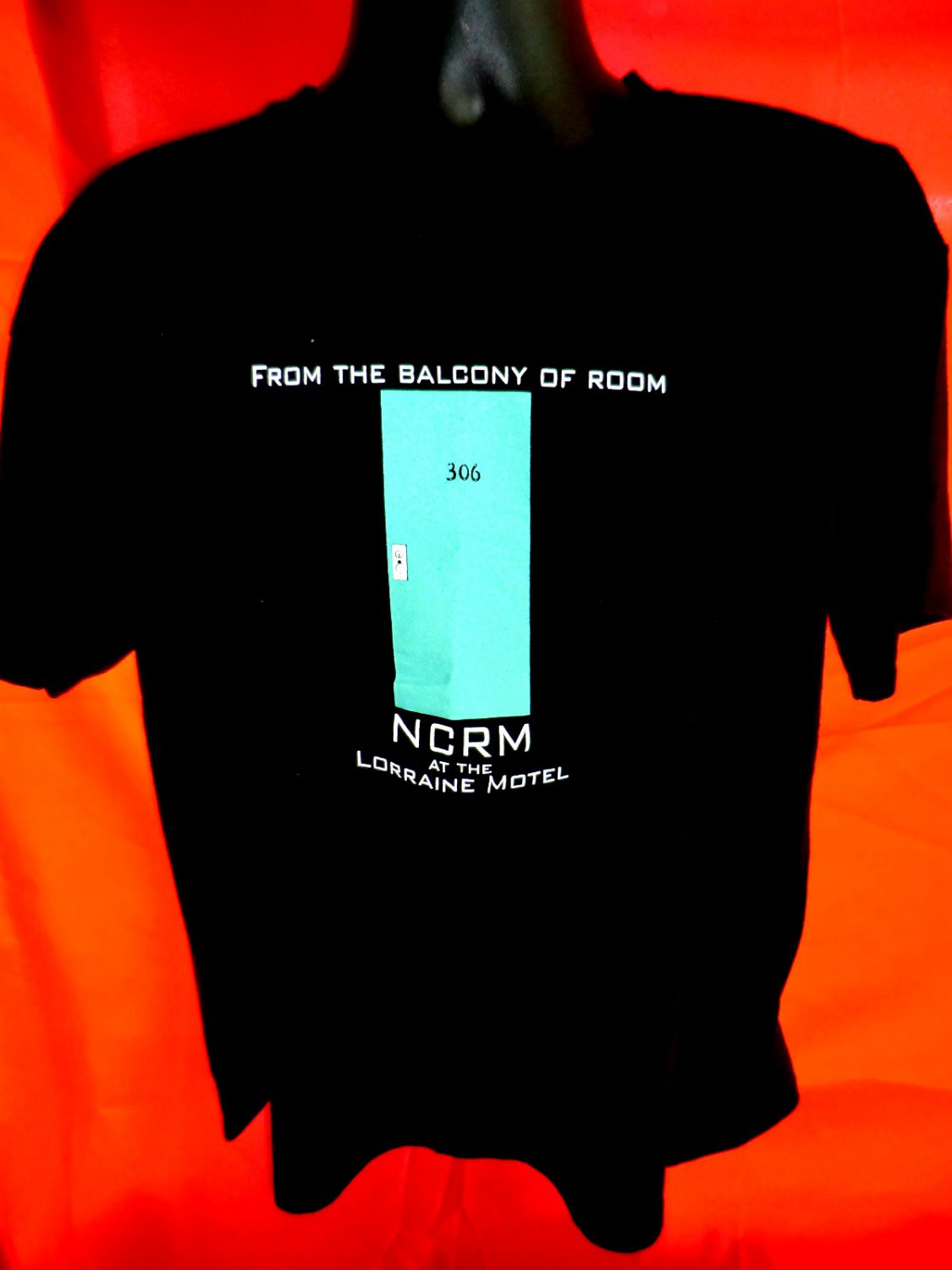
MLK Martin Luther King Jr ~ From the Balcony of Room 306 NCRM Lorraine Hotel T-Shirt Size Large
Only 1 available
Details
Shipping: United Kingdom: £13.00 (more destinations)
Condition: Used
*The store has not been updated recently. You may want to contact the merchant to confirm the availability of the product.


From the National Civil Rights Museum, here is a black, lightly pre-worn T-Shirt, size Large that has writing on the front and back of the shirt. On the front: From the Balcony of Room 306 NCRM Lorraine Hotel. On the back of the shirt: 306 You can Kill the Dreamer, But You Cannot Kill the Dream. This is where Martin Luther King was killed....
http://www.civilrightsmuseum.org/
The T-Shirt measures 23 inches across the chest measured under the arms and from the back of the neck band to the bottom hem are 28 inches—just a little short. The neck tag is missing so I am guessing that it is a 100% cotton with no holes or stains.
And just so you remember...
http://en.wikipedia.org/wiki/Martin_Luther_King,_Jr.
Martin Luther King, Jr. (January 15, 1929 – April 4, 1968) was an American pastor, activist, humanitarian, and leader in the African-American Civil Rights Movement. He is best known for his role in the advancement of civil rights using nonviolent civil disobedience based on his Christian beliefs.
He was born Michael King, but his father changed his name in honor of German reformer Martin Luther. A Baptist minister, King became a civil rights activist early in his career. He led the 1955 Montgomery Bus Boycott and helped found the Southern Christian Leadership Conference (SCLC) in 1957, serving as its first president. With the SCLC, King led an unsuccessful struggle against segregation in Albany, Georgia, in 1962, and organized nonviolent protests in Birmingham, Alabama, that attracted national attention following television news coverage of the brutal police response. King also helped to organize the 1963 March on Washington, where he delivered his "I Have a Dream" speech. There, he established his reputation as one of the greatest orators in American history. J. Edgar Hoover considered him a radical and made him an object of the Federal Bureau of Investigation's COINTELPRO for the rest of his life. FBI agents investigated him for possible communist ties, recorded his extramarital liaisons and reported on them to government officials, and on one occasion, mailed King a threatening anonymous letter which he interpreted as an attempt to make him commit suicide.
On October 14, 1964, King received the Nobel Peace Prize for combating racial inequality through nonviolence. In 1965, he and the SCLC helped to organize the Selma to Montgomery marches and the following year, he took the movement north to Chicago to work on segregated housing. In the final years of his life, King expanded his focus to include poverty and the Vietnam War, alienating many of his liberal allies with a 1967 speech titled "Beyond Vietnam". In 1968 King was planning a national occupation of Washington, D.C., to be called the Poor People's Campaign, when he was assassinated on April 4 in Memphis, Tennessee. His death was followed by riots in many U.S. cities.
http://www.civilrightsmuseum.org/
The T-Shirt measures 23 inches across the chest measured under the arms and from the back of the neck band to the bottom hem are 28 inches—just a little short. The neck tag is missing so I am guessing that it is a 100% cotton with no holes or stains.
And just so you remember...
http://en.wikipedia.org/wiki/Martin_Luther_King,_Jr.
Martin Luther King, Jr. (January 15, 1929 – April 4, 1968) was an American pastor, activist, humanitarian, and leader in the African-American Civil Rights Movement. He is best known for his role in the advancement of civil rights using nonviolent civil disobedience based on his Christian beliefs.
He was born Michael King, but his father changed his name in honor of German reformer Martin Luther. A Baptist minister, King became a civil rights activist early in his career. He led the 1955 Montgomery Bus Boycott and helped found the Southern Christian Leadership Conference (SCLC) in 1957, serving as its first president. With the SCLC, King led an unsuccessful struggle against segregation in Albany, Georgia, in 1962, and organized nonviolent protests in Birmingham, Alabama, that attracted national attention following television news coverage of the brutal police response. King also helped to organize the 1963 March on Washington, where he delivered his "I Have a Dream" speech. There, he established his reputation as one of the greatest orators in American history. J. Edgar Hoover considered him a radical and made him an object of the Federal Bureau of Investigation's COINTELPRO for the rest of his life. FBI agents investigated him for possible communist ties, recorded his extramarital liaisons and reported on them to government officials, and on one occasion, mailed King a threatening anonymous letter which he interpreted as an attempt to make him commit suicide.
On October 14, 1964, King received the Nobel Peace Prize for combating racial inequality through nonviolence. In 1965, he and the SCLC helped to organize the Selma to Montgomery marches and the following year, he took the movement north to Chicago to work on segregated housing. In the final years of his life, King expanded his focus to include poverty and the Vietnam War, alienating many of his liberal allies with a 1967 speech titled "Beyond Vietnam". In 1968 King was planning a national occupation of Washington, D.C., to be called the Poor People's Campaign, when he was assassinated on April 4 in Memphis, Tennessee. His death was followed by riots in many U.S. cities.
You may also be interested in:
-
£668.03
-
£5.62
-
£15.00
-
£113.26
-
£45.00
-
£45.00
-
£45.00
-
£45.00
-
£968.27
-
£97.57