
£97.57
Add to Cart
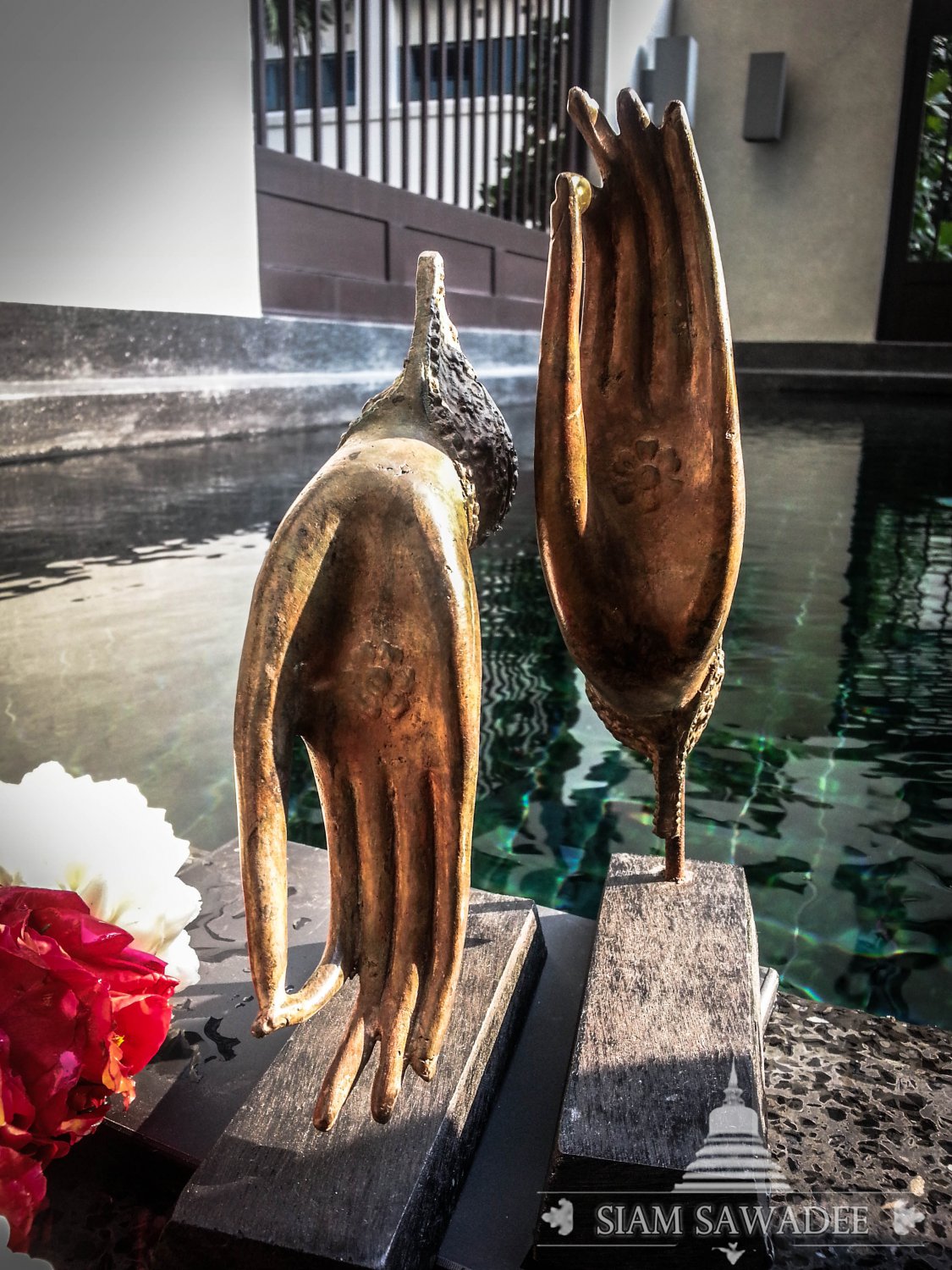
Pair of vintage Burmese bronze Siamese (Thai) Buddha hands offering blessings. FREE SHIPPING.
More than 10 available, 1 sold
Details
Shipping: United Kingdom: free (more destinations)
Condition: Used
*The store has not been updated recently. You may want to contact the merchant to confirm the availability of the product.


Things you should know about these hands.
Specifications (Per single item)
Height: 8" Inches
Width: 2" Inches
Weight: 770g (Combined weight)
Material: Bronze on wood mount.
Things you should know about the symbolism of these hands.
Mudras (A symbolic hand gesture)
Images of the Buddha were produced from the fifth century onwards. The sacred nature of the representation is reflected in the artistic goal of creating an aura of equanimity, perfection, and holiness. The large number of rules governing the execution of a portrayal or a statue require an erudite understanding of Buddhist symbolism. Any Buddha figure made by a skilled artist exhibits a multitude of characteristics that communicate subtle meanings and intentions to the viewer. The most important of these characteristics are perhaps the mudras, or hand gestures, of the Buddha. These well-defined gestures have a fixed meaning throughout all styles and periods of Buddha images.
Vitarka Mudra "Gesture of discussion" (Hand pointing up).
Intellectual argument, discussion. The circle formed by the thumb and index finger is the sign of the Wheel of Law.
Also called "The Gesture of Debate" or "argument" mudra. In this gesture the tips of thumb and index finger touched forming a circle. All the other fingers are extended upwards. This is the mystic gesture of Taras and Bodhisattvas, often used when explaining the Buddha's teachings.
Varada Mudra "Gesture of charity" (Hand pointing down).
Fulfilment of all wishes; the gesture of charity. This gesture is also called "Gift bestowing Gesture of Compassion" or "conferring boon" or "grace" mudra. The arm is extended all way down with palm facing outwards. You can find varadamudrâ sometimes also as a left-hand gesture. This is the mudra of Dhyani Buddha Ratnasamhava, Bodhisattva Avalokiteshvara and (sometimes) standing Buddha Shakyamuni.
Specifications (Per single item)
Height: 8" Inches
Width: 2" Inches
Weight: 770g (Combined weight)
Material: Bronze on wood mount.
Things you should know about the symbolism of these hands.
Mudras (A symbolic hand gesture)
Images of the Buddha were produced from the fifth century onwards. The sacred nature of the representation is reflected in the artistic goal of creating an aura of equanimity, perfection, and holiness. The large number of rules governing the execution of a portrayal or a statue require an erudite understanding of Buddhist symbolism. Any Buddha figure made by a skilled artist exhibits a multitude of characteristics that communicate subtle meanings and intentions to the viewer. The most important of these characteristics are perhaps the mudras, or hand gestures, of the Buddha. These well-defined gestures have a fixed meaning throughout all styles and periods of Buddha images.
Vitarka Mudra "Gesture of discussion" (Hand pointing up).
Intellectual argument, discussion. The circle formed by the thumb and index finger is the sign of the Wheel of Law.
Also called "The Gesture of Debate" or "argument" mudra. In this gesture the tips of thumb and index finger touched forming a circle. All the other fingers are extended upwards. This is the mystic gesture of Taras and Bodhisattvas, often used when explaining the Buddha's teachings.
Varada Mudra "Gesture of charity" (Hand pointing down).
Fulfilment of all wishes; the gesture of charity. This gesture is also called "Gift bestowing Gesture of Compassion" or "conferring boon" or "grace" mudra. The arm is extended all way down with palm facing outwards. You can find varadamudrâ sometimes also as a left-hand gesture. This is the mudra of Dhyani Buddha Ratnasamhava, Bodhisattva Avalokiteshvara and (sometimes) standing Buddha Shakyamuni.
You may also be interested in:
-
£74.97
-
£18.77
-
£7,505.99
-
£59.30
-
£48.79
-
£36.03
-
£37.53
-
£12.00

-
£100.51
-
£48.03


 TH, Bangkok
