
£33.78
Add to Cart
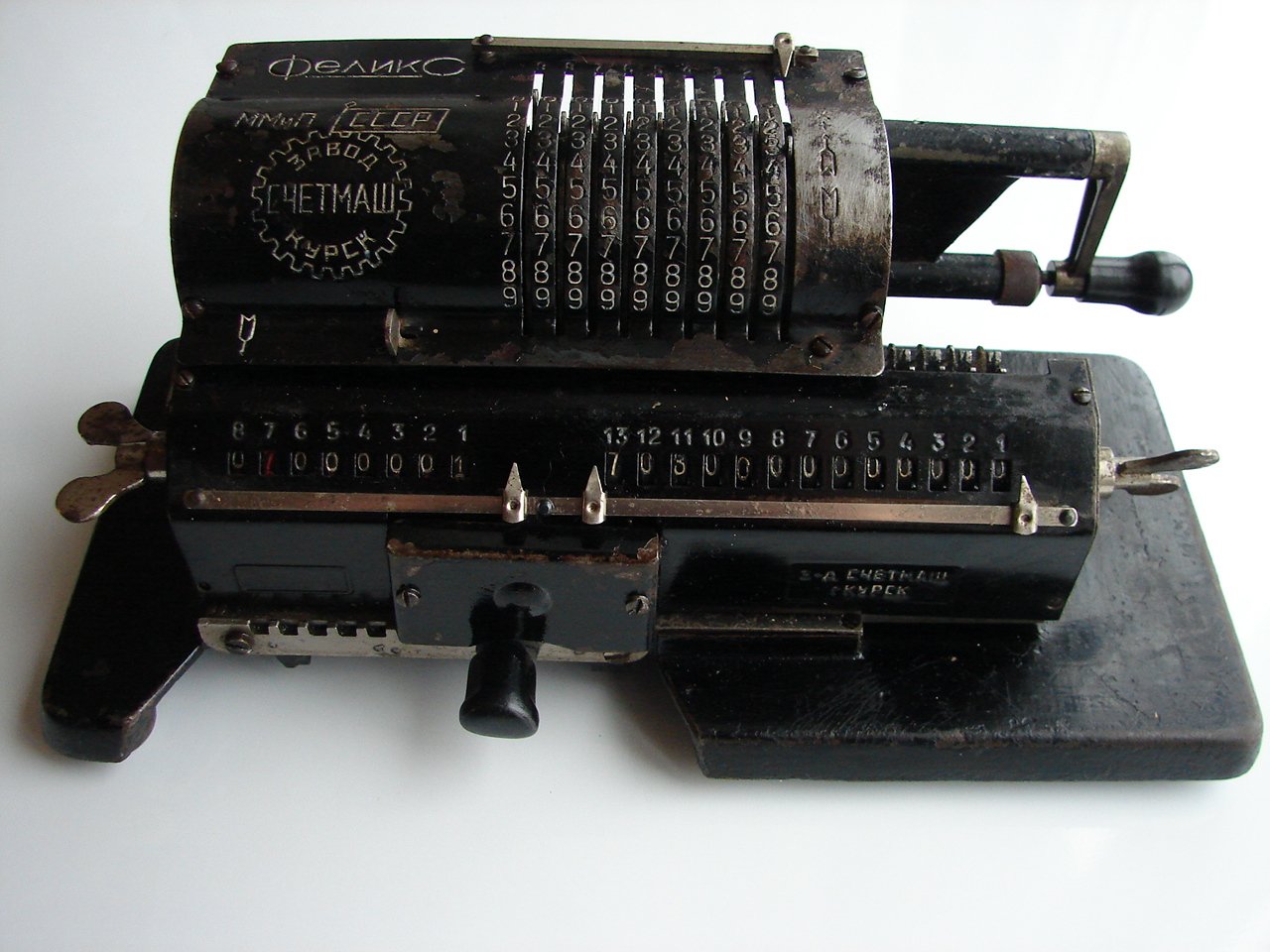
The Adding Machine "Felix"
Only 1 available
Details
Shipping: United Kingdom: free (more destinations)
Condition: Brand new
*The store has not been updated recently. You may want to contact the merchant to confirm the availability of the product.


The inscription "Mmip the USSR Plant SCHEMAS Kursk". 1950-ies.
Adding machine systems Odner "Felix".
On the adding machine system Odner could perform four arithmetic operations - addition, subtraction, multiplication and division. The model has been so successful that its various modifications more than half a century was produced in many countries of the world.
The adding machine (from the Greek. αριθμός - stop number) table mechanical computing machine is manually operated to perform arithmetic operations.
The prototype of adding machines, widely spread in the 1st half of the XX century, served as a computing machine, invented in 1890 by the Russian mechanic V. T. Odner. Odner replaced the speed cushions Leibniz gear wheel with a varying number of teeth.
For many decades the adding machine was the most common computing machine. Only the distribution of electronic calculators replaced Odner adding machine from General consumption.
Cradle guide:
Addition:
1. Set on the levers the rst term.
2. Turn the knob away from you (clockwise). The number on the levers is entered into the counter summation.
3. Set on the levers, the second term.
4. Turn the knob yourself . The number on the levers will be added to the number in the counter summation.
5. The result of adding - on the counter of summation.
Subtraction:
1. Set on the levers minuend.
2. Turn the knob yourself. The number on the levers is entered into the counter summation.
3. Set on the levers subtrahend.
4. Turn the handle. The number on the levers is subtracted from the number on the counter is the summation.
5. The result of subtracting the summation counter.
If the subtraction is a negative number, adding machine rings a bell. As an adding machine does not operate with negative numbers, we must "undo" the last action: without changing the position of the levers and the console, turn the knob in the opposite direction.
Multiplication:
Multiplication by a small number
1. Set on the levers of the first multiplier.
2. Turn the knob away from you until the meter spins will not appear the second multiplier.
3. The result of the multiplication - summation counter.
Multiplication via the console
By analogy with multiplication column is multiplied by each digit, recording the results with offset. The offset is determined by which discharge is the second multiplier.
To move the console, use the knob on the front of the adding machine (Felix) or arrow keys (VK-1, Rheinmetall).
Let us consider an example: 1234 × 5678:
1. Move the console to the left.
2. Set on the levers multiplier greater (approximately) the sum of digits (5678).
3. Turn the knob away from you until the meter spins will not appear the first digit (to the right) of the second multiplier (4).
4. Move the console one step to the right.
5. Similarly repeat items 3 and 4 for the remaining digits (2nd, 3rd and 4th). In the end, the meter spins needs to be the second multiplier (1234).
6. The result of the multiplication - summation counter.
Division:
Consider the case of dividing 8765 432:
1. Set on the levers dividend. (8765)
2. Move the console to the fifth digit (four steps to the right).
3. Mark the end of an entire part of the dividend metal "commas" on all counters (commas should stand in the bar before figure 5).
4. Turn the knob myself. In this case the dividend is entered into the counter summation.
5. To reset the meter spins.
6. Set on the levers divider (432).
7. Move the bracket so that the MSB of the dividend are aligned with the high bit of the divisor, that is one step to the right.
8. Twist the stick until you get a negative number (overkill, celebrated with a bell sound). Return handle one turn back.
9. Move the console one step to the left.
10. Make paragraphs 8 and 9 to the extreme position of the console.
11. The result is the module number on the meter spins the integer and fractional parts separated by a comma. The rest on the counter summation.
The square root:
One of the most convenient methods are based on the following considerations. Let (10x + y) is the desired root (two digits). 5 cdot (10x + y)^2 = 500x^2 + 100xy + 5y^2, the latter is expressed in two amounts:
500x^2 = 500 + 1500 + 2500 + ... (x summands),
100xy + 5y^2 = (100x + 5) + (100x + 15) + (100x + 25) + ... (y components).
Subtracting from this five-square consistently mentioned components, by their number determined by the numbers of the root. The method can be generalized to an arbitrary number razryadivshijsya from this five-square consistently mentioned components, by their number determined by the numbers of the root. The method can be generalized to an arbitrary number of bits.
1. Set on the levers of the number.
2. Make five turns from himself, to add to the adder five-times square (the number of digits must be even, in the event the need to shift the number to the digit to the right, adding it to the left of zero).
3. Reset the set and type 05 in the two leftmost bits .
4. Take a spin for yourself.
5. Repeat the last two steps instead of dialing zero sequence 1, 2, 3, etc. Select the digit is the first digit of the root.
6. If the result is negative (the bell) take a spin myself.
7. Slip the balance on the category of left
8. Replace in the set the last digit from 5 to 0 and dial the number 5 to the right
9. Perform the subtraction, as described above, sequentially changing the penultimate digit wichitaeagle (the next digit of the desired root) 0, 1, 2, etc.
10. Repeat the last four steps, calculating the root digit after another, until you reach the required accuracy.
Age : 1950 - 1960
Country : USSR
Condition : good ( lacking rear cover)
Adding machine systems Odner "Felix".
On the adding machine system Odner could perform four arithmetic operations - addition, subtraction, multiplication and division. The model has been so successful that its various modifications more than half a century was produced in many countries of the world.
The adding machine (from the Greek. αριθμός - stop number) table mechanical computing machine is manually operated to perform arithmetic operations.
The prototype of adding machines, widely spread in the 1st half of the XX century, served as a computing machine, invented in 1890 by the Russian mechanic V. T. Odner. Odner replaced the speed cushions Leibniz gear wheel with a varying number of teeth.
For many decades the adding machine was the most common computing machine. Only the distribution of electronic calculators replaced Odner adding machine from General consumption.
Cradle guide:
Addition:
1. Set on the levers the rst term.
2. Turn the knob away from you (clockwise). The number on the levers is entered into the counter summation.
3. Set on the levers, the second term.
4. Turn the knob yourself . The number on the levers will be added to the number in the counter summation.
5. The result of adding - on the counter of summation.
Subtraction:
1. Set on the levers minuend.
2. Turn the knob yourself. The number on the levers is entered into the counter summation.
3. Set on the levers subtrahend.
4. Turn the handle. The number on the levers is subtracted from the number on the counter is the summation.
5. The result of subtracting the summation counter.
If the subtraction is a negative number, adding machine rings a bell. As an adding machine does not operate with negative numbers, we must "undo" the last action: without changing the position of the levers and the console, turn the knob in the opposite direction.
Multiplication:
Multiplication by a small number
1. Set on the levers of the first multiplier.
2. Turn the knob away from you until the meter spins will not appear the second multiplier.
3. The result of the multiplication - summation counter.
Multiplication via the console
By analogy with multiplication column is multiplied by each digit, recording the results with offset. The offset is determined by which discharge is the second multiplier.
To move the console, use the knob on the front of the adding machine (Felix) or arrow keys (VK-1, Rheinmetall).
Let us consider an example: 1234 × 5678:
1. Move the console to the left.
2. Set on the levers multiplier greater (approximately) the sum of digits (5678).
3. Turn the knob away from you until the meter spins will not appear the first digit (to the right) of the second multiplier (4).
4. Move the console one step to the right.
5. Similarly repeat items 3 and 4 for the remaining digits (2nd, 3rd and 4th). In the end, the meter spins needs to be the second multiplier (1234).
6. The result of the multiplication - summation counter.
Division:
Consider the case of dividing 8765 432:
1. Set on the levers dividend. (8765)
2. Move the console to the fifth digit (four steps to the right).
3. Mark the end of an entire part of the dividend metal "commas" on all counters (commas should stand in the bar before figure 5).
4. Turn the knob myself. In this case the dividend is entered into the counter summation.
5. To reset the meter spins.
6. Set on the levers divider (432).
7. Move the bracket so that the MSB of the dividend are aligned with the high bit of the divisor, that is one step to the right.
8. Twist the stick until you get a negative number (overkill, celebrated with a bell sound). Return handle one turn back.
9. Move the console one step to the left.
10. Make paragraphs 8 and 9 to the extreme position of the console.
11. The result is the module number on the meter spins the integer and fractional parts separated by a comma. The rest on the counter summation.
The square root:
One of the most convenient methods are based on the following considerations. Let (10x + y) is the desired root (two digits). 5 cdot (10x + y)^2 = 500x^2 + 100xy + 5y^2, the latter is expressed in two amounts:
500x^2 = 500 + 1500 + 2500 + ... (x summands),
100xy + 5y^2 = (100x + 5) + (100x + 15) + (100x + 25) + ... (y components).
Subtracting from this five-square consistently mentioned components, by their number determined by the numbers of the root. The method can be generalized to an arbitrary number razryadivshijsya from this five-square consistently mentioned components, by their number determined by the numbers of the root. The method can be generalized to an arbitrary number of bits.
1. Set on the levers of the number.
2. Make five turns from himself, to add to the adder five-times square (the number of digits must be even, in the event the need to shift the number to the digit to the right, adding it to the left of zero).
3. Reset the set and type 05 in the two leftmost bits .
4. Take a spin for yourself.
5. Repeat the last two steps instead of dialing zero sequence 1, 2, 3, etc. Select the digit is the first digit of the root.
6. If the result is negative (the bell) take a spin myself.
7. Slip the balance on the category of left
8. Replace in the set the last digit from 5 to 0 and dial the number 5 to the right
9. Perform the subtraction, as described above, sequentially changing the penultimate digit wichitaeagle (the next digit of the desired root) 0, 1, 2, etc.
10. Repeat the last four steps, calculating the root digit after another, until you reach the required accuracy.
Age : 1950 - 1960
Country : USSR
Condition : good ( lacking rear cover)


 UA, Kharkov
