
£11.26
Add to Cart
Vizomitin Eye Drops (Skulachev ions SkQ1) 5ml
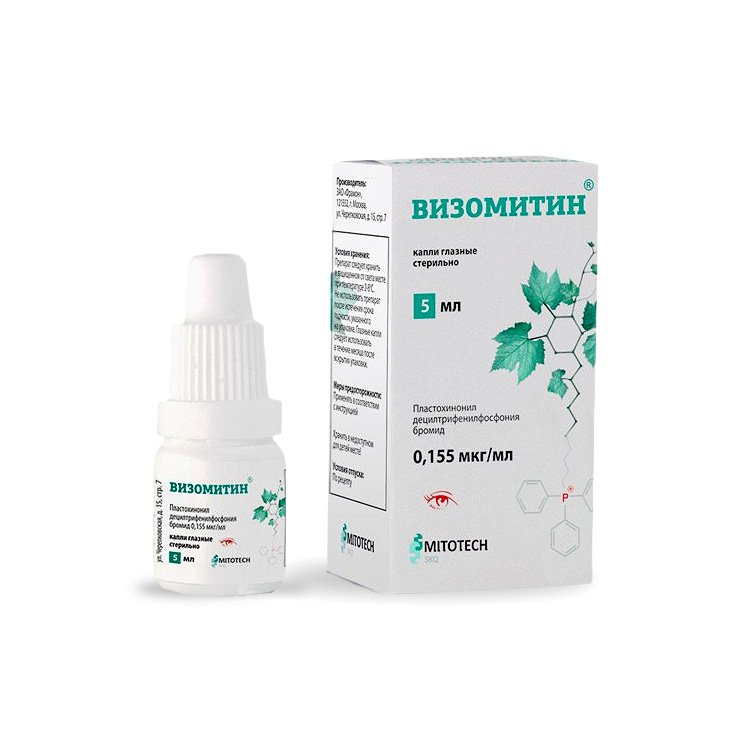
Visomitin SkQ1 works on a cellular level by reducing damage caused by excessive reactive oxygen species (ROS), which are types of free radicals that play an important role in cell signaling. SkQ1 also selectively protects membrane’s cardiolipin from oxidation and by doing so prevents mitochondrial dysfunction and process of cell death called apoptosis. Another feature of the compound is that its oxidation chemistry allows it to be recycled in the mitochondria, creating a renewable antioxidant. The company has built its clinical development program to leverage SkQ1 across age-related disorders that could include treating neurodegenerative diseases like Parkinson’s and Alzheimer’s.
“SkQ1 was developed as an agent fighting a spectrum of age-related diseases at their root, which in our hypothesis is oxidative stress inside mitochondria,” Natalia Perekhvatova, Mitotech’s chief executive, said. “In case of Dry Eye Disease our ophthalmic solution Visomitin has been shown not only to suppress inflammation, but also to protect corneal and conjunctival cells from damage and to promote health of lacrimal glands, therefore addressing the disease from multiple angles.”
Mitotech’s program for the treatment of Dry Eye Disease is focused on Visomitin, which is approved in Russia and had a successful Phase II study in the U.S. that indicated statistically significant effect of SkQ1 on both signs and symptoms of dry eye.
The company is currently preparing Visomitin for Phase III trials, with a goal of getting the compound before the FDA by 2019.
On-label indications:
Dry eye syndrome
Initial stage of age-related cataract
Cataracts and glaucoma, including their most bad choices
Uveitis
Enteral inflammations
Neurodegeneration
SkQ1- a cardiolipin peroxidation inhibitor
A few years ago a small molecule SkQ1 was synthesized in the Moscow State University. One part of SkQ1 functions as a molecular “tow truck”, carrying the other part of the molecule – an extremely active antioxidant plastoquinone – into mitochondria. SkQ1 has been shown to accumulate in mitochondria in an extremely targeted and efficient manner. The physics of the mitochondrial membrane and the unique properties of SkQ1 direct it into the inner leaflet of the inner mitochondrial membrane with incredibly high precision. The molecule was designed to act as a mitochondria-targeted ROS scavenger in general and as a very efficient cardiolipin peroxidation inhibitor in particular
“SkQ1 was developed as an agent fighting a spectrum of age-related diseases at their root, which in our hypothesis is oxidative stress inside mitochondria,” Natalia Perekhvatova, Mitotech’s chief executive, said. “In case of Dry Eye Disease our ophthalmic solution Visomitin has been shown not only to suppress inflammation, but also to protect corneal and conjunctival cells from damage and to promote health of lacrimal glands, therefore addressing the disease from multiple angles.”
Mitotech’s program for the treatment of Dry Eye Disease is focused on Visomitin, which is approved in Russia and had a successful Phase II study in the U.S. that indicated statistically significant effect of SkQ1 on both signs and symptoms of dry eye.
The company is currently preparing Visomitin for Phase III trials, with a goal of getting the compound before the FDA by 2019.
On-label indications:
Dry eye syndrome
Initial stage of age-related cataract
Cataracts and glaucoma, including their most bad choices
Uveitis
Enteral inflammations
Neurodegeneration
SkQ1- a cardiolipin peroxidation inhibitor
A few years ago a small molecule SkQ1 was synthesized in the Moscow State University. One part of SkQ1 functions as a molecular “tow truck”, carrying the other part of the molecule – an extremely active antioxidant plastoquinone – into mitochondria. SkQ1 has been shown to accumulate in mitochondria in an extremely targeted and efficient manner. The physics of the mitochondrial membrane and the unique properties of SkQ1 direct it into the inner leaflet of the inner mitochondrial membrane with incredibly high precision. The molecule was designed to act as a mitochondria-targeted ROS scavenger in general and as a very efficient cardiolipin peroxidation inhibitor in particular


 KZ, Astana
