
£25.67
Add to Cart
Exomitin 50ml Regenerating hydrogel SkQ1 Skulachev ions
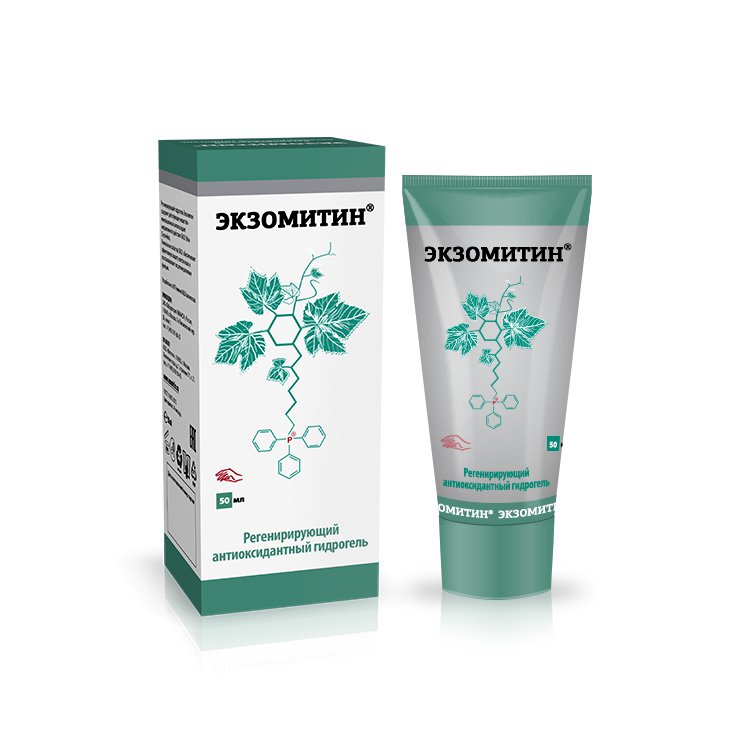
Hydrogel Exomitin® enhances antioxidant defense of the skin cells and improves their regenerative functions.
Due to the innovative formula, the mitochondrial antioxidant SkQ1 provides a protective and soothing effect in case of skin irritation, redness and dryness. Preclinical studies show that SkQ1 has an anti-inflammatory activity and enables skin to recover from damage.The most impressive results occur in the models of old animals and animals suffering from diabetes. As we all known, due to the reduced regenerative ability, which accompany aging and diabetes, even minor injuries or wounds heal much longer. In our scientific experiments, antioxidant SkQ1 perfectly stimulated the necessary wound healing and skin regeneration without scarring and other complications...
SkQ1 has been developed in Moscow State University in group of Professor V. Skulachev. Long-term scientific and clinical studies have shown that SkQ1 slow down, stop or reverse the progression of many traits of aging. The unique feature of extremely effective antioxidant SkQ1, is the ability to penetrate into cells and to accumulate directly in the place of free radicals formation – in the mitochondria.
Scientific background of the product:
1) Mitochondria-Targeted Antioxidant SkQ1 Improves Dermal Wound Healing in Genetically Diabetic Mice. Demyanenko IA, Zakharova VV, Ilyinskaya OP, Vasilieva TV, Fedorov AV, Manskikh VN, Zinovkin RA, Pletjushkina OY, Chernyak BV, Skulachev VP, Popova EN. Oxid Med Cell Longev. 2017.
2) Mitochondria-targeted antioxidant SkQ1 improves impaired dermal wound healing in old mice. Demyanenko IA, Popova EN, Zakharova VV, Ilyinskaya OP, Vasilieva TV, Romashchenko VP, Fedorov AV, Manskikh VN, Skulachev MV, Zinovkin RA, Pletjushkina OY, Skulachev VP, Chernyak BV. Aging (Albany NY). 2015 Jul;7(7):475-85
3) Novel mitochondria-targeted antioxidants, "Skulachev-ion" derivatives, accelerate dermal wound healing in animals. Demianenko IA, Vasilieva TV, Domnina LV, Dugina VB, Egorov MV, Ivanova OY, Ilinskaya OP, Pletjushkina OY, Popova EN, Sakharov IY, Fedorov AV, Chernyak BV. Biochemistry (Mosc). 2010 Mar;75(3):274-80
Due to the innovative formula, the mitochondrial antioxidant SkQ1 provides a protective and soothing effect in case of skin irritation, redness and dryness. Preclinical studies show that SkQ1 has an anti-inflammatory activity and enables skin to recover from damage.The most impressive results occur in the models of old animals and animals suffering from diabetes. As we all known, due to the reduced regenerative ability, which accompany aging and diabetes, even minor injuries or wounds heal much longer. In our scientific experiments, antioxidant SkQ1 perfectly stimulated the necessary wound healing and skin regeneration without scarring and other complications...
SkQ1 has been developed in Moscow State University in group of Professor V. Skulachev. Long-term scientific and clinical studies have shown that SkQ1 slow down, stop or reverse the progression of many traits of aging. The unique feature of extremely effective antioxidant SkQ1, is the ability to penetrate into cells and to accumulate directly in the place of free radicals formation – in the mitochondria.
Scientific background of the product:
1) Mitochondria-Targeted Antioxidant SkQ1 Improves Dermal Wound Healing in Genetically Diabetic Mice. Demyanenko IA, Zakharova VV, Ilyinskaya OP, Vasilieva TV, Fedorov AV, Manskikh VN, Zinovkin RA, Pletjushkina OY, Chernyak BV, Skulachev VP, Popova EN. Oxid Med Cell Longev. 2017.
2) Mitochondria-targeted antioxidant SkQ1 improves impaired dermal wound healing in old mice. Demyanenko IA, Popova EN, Zakharova VV, Ilyinskaya OP, Vasilieva TV, Romashchenko VP, Fedorov AV, Manskikh VN, Skulachev MV, Zinovkin RA, Pletjushkina OY, Skulachev VP, Chernyak BV. Aging (Albany NY). 2015 Jul;7(7):475-85
3) Novel mitochondria-targeted antioxidants, "Skulachev-ion" derivatives, accelerate dermal wound healing in animals. Demianenko IA, Vasilieva TV, Domnina LV, Dugina VB, Egorov MV, Ivanova OY, Ilinskaya OP, Pletjushkina OY, Popova EN, Sakharov IY, Fedorov AV, Chernyak BV. Biochemistry (Mosc). 2010 Mar;75(3):274-80


 KZ, Astana
