£10.99
On Hold
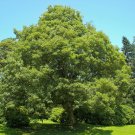
Quercus virginiana Live oak 5 Seeds
3 available
Details
Shipping: United Kingdom: £7.00 (more destinations)
Sales Tax: check
Condition: Brand new
*The store has not been updated recently. You may want to contact the merchant to confirm the availability of the product.
Quercus virginiana
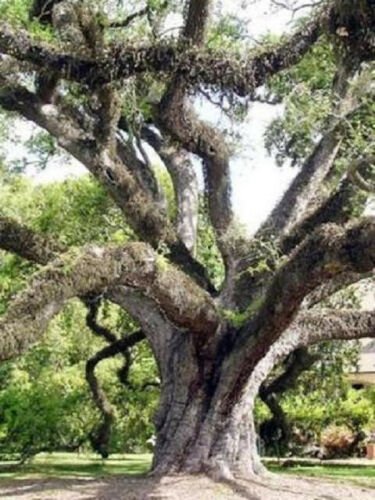
Depending on the growing conditions, live oaks vary from the shrubby to large and spreading: typical open-grown trees reach 15 meters (50 feet) in height, but may span nearly 50 meters. Their lower limbs often sweep down towards the ground before curving up again. They can grow at severe angles, and Native Americans used to bend saplings over so that they would grow at extreme angles, to serve as trail markers. They drop their leaves, and grow new ones, within a few weeks in spring. The bark is furrowed longitudinally, and the acorns are small, but long and tapered. The branches frequently support other plant species such as rounded clumps of ball moss, thick drapings of Spanish moss, Resurrection fern, and parasitic mistletoe.
Southern live oak can grow in moist to dry sites. They can withstand occasional floods and hurricanes, and are resistant to salt spray and moderate soil salinity. They tend to survive fire, because often a fire will not reach their crowns. Even if a tree is burned, its crowns and roots usually survive the fire and sprout vigorously. Furthermore live oak forests discourage entry of fire from adjacent communities because they provide dense cover that discourages the growth of a flammable understory. Although they grow best in well-drained sandy soils and loams, they will also grow in clay. Live oaks are also surprisingly hardy. Those of southern provenance can easily be grown in USDA zone 7 and the Texas Live Oak (Quercus virginiana var. fusiformis), having the same evergreen foliage as the Southern variety, can be grown with success in areas as cold as zone 6. Even with significant winter leaf burn, these trees can make a strong comeback during the growing season in more northerly areas such New Jersey, southern Ohio, and southern Connecticut.
Among the animals for which live oak acorns are an important food source are the bobwhite quail, the threatened Florida scrub jay, the wood duck, yellow-bellied sapsucker, wild turkey, black bear, various species of squirrel, and the white-tailed deer. The tree crown is very dense, making it valuable for shade, and the species provides nest sites for many other species.
Live oak wood is hard, heavy, and difficult to work, but very strong. In the days of wooden ships, live oaks were the preferred source of the framework timbers of the ship, using the natural trunk and branch angles for their strength. The frame of USS Constitution was constructed from Southern live oak wood harvested from St. Simons Island, Georgia, and the density of the wood grain allowed it to survive cannonade, thus earning it the nickname "Old Ironsides". Even today the U.S. Navy owns extensive live oak tracts. Several live oaks are notable landmarks, including two named the "Treaty Oak;" one in Texas and another in Florida. Native Americans extracted an oil from the acorns.
Care for the Southern live oak is very easy, as it requires very little watering while it is young. After it is 4 to 5 feet tall, watering can be forgotten, and no more care is required. Southern live oak is long-lived. Trees in excess of 500 years were once common, and one, the Angel Oak on Johns Island, South Carolina is estimated at 1400 years of age; it is 20 m tall, 2.47 m diameter, and with a maximum spread (longest branch) of 27 m; the crown covers an area of 1,580 m2.
Depending on the growing conditions, live oaks vary from the shrubby to large and spreading: typical open-grown trees reach 15 meters (50 feet) in height, but may span nearly 50 meters. Their lower limbs often sweep down towards the ground before curving up again. They can grow at severe angles, and Native Americans used to bend saplings over so that they would grow at extreme angles, to serve as trail markers. They drop their leaves, and grow new ones, within a few weeks in spring. The bark is furrowed longitudinally, and the acorns are small, but long and tapered. The branches frequently support other plant species such as rounded clumps of ball moss, thick drapings of Spanish moss, Resurrection fern, and parasitic mistletoe.
Southern live oak can grow in moist to dry sites. They can withstand occasional floods and hurricanes, and are resistant to salt spray and moderate soil salinity. They tend to survive fire, because often a fire will not reach their crowns. Even if a tree is burned, its crowns and roots usually survive the fire and sprout vigorously. Furthermore live oak forests discourage entry of fire from adjacent communities because they provide dense cover that discourages the growth of a flammable understory. Although they grow best in well-drained sandy soils and loams, they will also grow in clay. Live oaks are also surprisingly hardy. Those of southern provenance can easily be grown in USDA zone 7 and the Texas Live Oak (Quercus virginiana var. fusiformis), having the same evergreen foliage as the Southern variety, can be grown with success in areas as cold as zone 6. Even with significant winter leaf burn, these trees can make a strong comeback during the growing season in more northerly areas such New Jersey, southern Ohio, and southern Connecticut.
Among the animals for which live oak acorns are an important food source are the bobwhite quail, the threatened Florida scrub jay, the wood duck, yellow-bellied sapsucker, wild turkey, black bear, various species of squirrel, and the white-tailed deer. The tree crown is very dense, making it valuable for shade, and the species provides nest sites for many other species.
Live oak wood is hard, heavy, and difficult to work, but very strong. In the days of wooden ships, live oaks were the preferred source of the framework timbers of the ship, using the natural trunk and branch angles for their strength. The frame of USS Constitution was constructed from Southern live oak wood harvested from St. Simons Island, Georgia, and the density of the wood grain allowed it to survive cannonade, thus earning it the nickname "Old Ironsides". Even today the U.S. Navy owns extensive live oak tracts. Several live oaks are notable landmarks, including two named the "Treaty Oak;" one in Texas and another in Florida. Native Americans extracted an oil from the acorns.
Care for the Southern live oak is very easy, as it requires very little watering while it is young. After it is 4 to 5 feet tall, watering can be forgotten, and no more care is required. Southern live oak is long-lived. Trees in excess of 500 years were once common, and one, the Angel Oak on Johns Island, South Carolina is estimated at 1400 years of age; it is 20 m tall, 2.47 m diameter, and with a maximum spread (longest branch) of 27 m; the crown covers an area of 1,580 m2.
You may also be interested in:
-
£5.25
-
£4.86
-
£1.31
-
£1.31

-
£6.75
-
£1.50
-
£6.75
-
£428.62
-
£1.31
-
£2.25