£110.00
Add to Cart
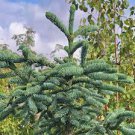
Abies balsamea BALSAM FIR Tree Seeds!

More than 10 available
Details
Shipping: United Kingdom: free (more destinations)
Sales Tax: check
Condition: Brand new
Balsam fir can also reproduce vegetatively by layering. Layering is common in swamps and mossy areas, but can also occur on drier sites, under a canopy of jack pine (Pinus banksiana) and eastern white pine (Pinus strobus). Trees at high elevation, especially near the treeline, reproduce primarily by layering.
This tree grows at a slow rate, with height increases of less than 12" per year.
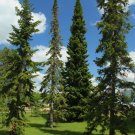
Balsam fir (Abies balsamea) is one of the more important conifers in the northern United States and in Canada. Within its range it may also be referred to as balsam, Canadian balsam, eastern fir, and bracted balsam fir.
Balsam fir trees are medium-sized evergreen conifers. They are often used as Christmas trees because of their pleasant smell and the fact that their needles remain in place long after the trees have been cut.
Deer are herbivores — they eat plants. Conifers are plants. If a deer is hungry enough, any plant is on the menu unless it's toxic. Firs are not toxic.. . . . .364011234478!]0000000000000009783314147124!]
This tree grows at a slow rate, with height increases of less than 12" per year.
Balsam fir (Abies balsamea) is one of the more important conifers in the northern United States and in Canada. Within its range it may also be referred to as balsam, Canadian balsam, eastern fir, and bracted balsam fir.
Balsam fir trees are medium-sized evergreen conifers. They are often used as Christmas trees because of their pleasant smell and the fact that their needles remain in place long after the trees have been cut.
Deer are herbivores — they eat plants. Conifers are plants. If a deer is hungry enough, any plant is on the menu unless it's toxic. Firs are not toxic.. . . . .364011234478!]0000000000000009783314147124!]
You may also be interested in:
-
£8.35
-
£4.71
-
£5.46
-
£8.25
-
£10.19
-
£9.20
-
£7.19
-
£9.98

-
£6.44
-
£10.51