
£224.51
Add to Cart
Carya illinoinensis Live Plants Bareroot Seedlings 30 Pecan Trees
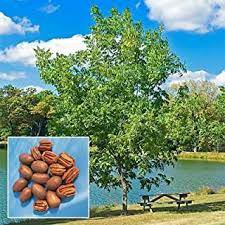
Hardy pecan grows best in full sun to partial shade. It tolerates clay, sand, and loam soils—alkaline or acidic—as long as they are well drained. It has high drought tolerance.
Pecan trees can reach up to 130 feet in height but will usually grow 70 to 100 feet tall with a spread of 40 to 75 feet. The largest of the hickories, this deciduous tree has a uniform, symmetrical, broadly oval crown and is massively-branched. Large major limbs grow up and out from the trunk in a distinctive upright, spreading fashion. On older trees, lower branches become wide-sweeping, with their tips almost touching the ground. Trunks can grow to 6 feet in diameter.
Pollination is the second most important factor in purchasing pecan trees. Pecan trees are monoecious: they have separate male and female flowers on the same tree. Pollen is not released when flowers are receptive, so pollination within and between the same cultivars is limited. Cultivars are separated into type I and type II for pollination purposes. For optimum pollination, NC State Extension recommends planting at least three cultivars with at least one of each pollination type for best cross-pollination. All cultivars have positive and negative attributes, so do your research before purchasing.
Nut production can be reduced in the northern part of its growing range, especially when spring is late and the summer is cool. It can be difficult to transplant due to a deep taproot, so choose your planting location wisely with its large mature size in mind. You can grow it from seed, but it will take the better part of a decade before the tree produces a significant crop. Pecans tolerate being planted near black walnut trees. This tree requires a medium amount of maintenance.
Due to its size, this is a tree most appropriate for a large property. It makes a good shade tree in a naturalized, woodland, or recreational area and as part of a children’s, edible, or pollinator garden.
Estimate Shipping to US 3-6 Days
Pecan trees can reach up to 130 feet in height but will usually grow 70 to 100 feet tall with a spread of 40 to 75 feet. The largest of the hickories, this deciduous tree has a uniform, symmetrical, broadly oval crown and is massively-branched. Large major limbs grow up and out from the trunk in a distinctive upright, spreading fashion. On older trees, lower branches become wide-sweeping, with their tips almost touching the ground. Trunks can grow to 6 feet in diameter.
Pollination is the second most important factor in purchasing pecan trees. Pecan trees are monoecious: they have separate male and female flowers on the same tree. Pollen is not released when flowers are receptive, so pollination within and between the same cultivars is limited. Cultivars are separated into type I and type II for pollination purposes. For optimum pollination, NC State Extension recommends planting at least three cultivars with at least one of each pollination type for best cross-pollination. All cultivars have positive and negative attributes, so do your research before purchasing.
Nut production can be reduced in the northern part of its growing range, especially when spring is late and the summer is cool. It can be difficult to transplant due to a deep taproot, so choose your planting location wisely with its large mature size in mind. You can grow it from seed, but it will take the better part of a decade before the tree produces a significant crop. Pecans tolerate being planted near black walnut trees. This tree requires a medium amount of maintenance.
Due to its size, this is a tree most appropriate for a large property. It makes a good shade tree in a naturalized, woodland, or recreational area and as part of a children’s, edible, or pollinator garden.
Estimate Shipping to US 3-6 Days
Other Products from enternity (View All)
-
£51.92
-
£96.94
-
£147.22
-
£45.92
-
£88.69
-
£129.96
-
£40.66
-
£76.68
-
£138.22
-
£40.66



 ID, DI Yogyakarta
