
£30.02
Add to Cart
Cat Stevens - Teaser and the Firecat 1971 A&M Quadraphonic T21 8-TRACK TAPE
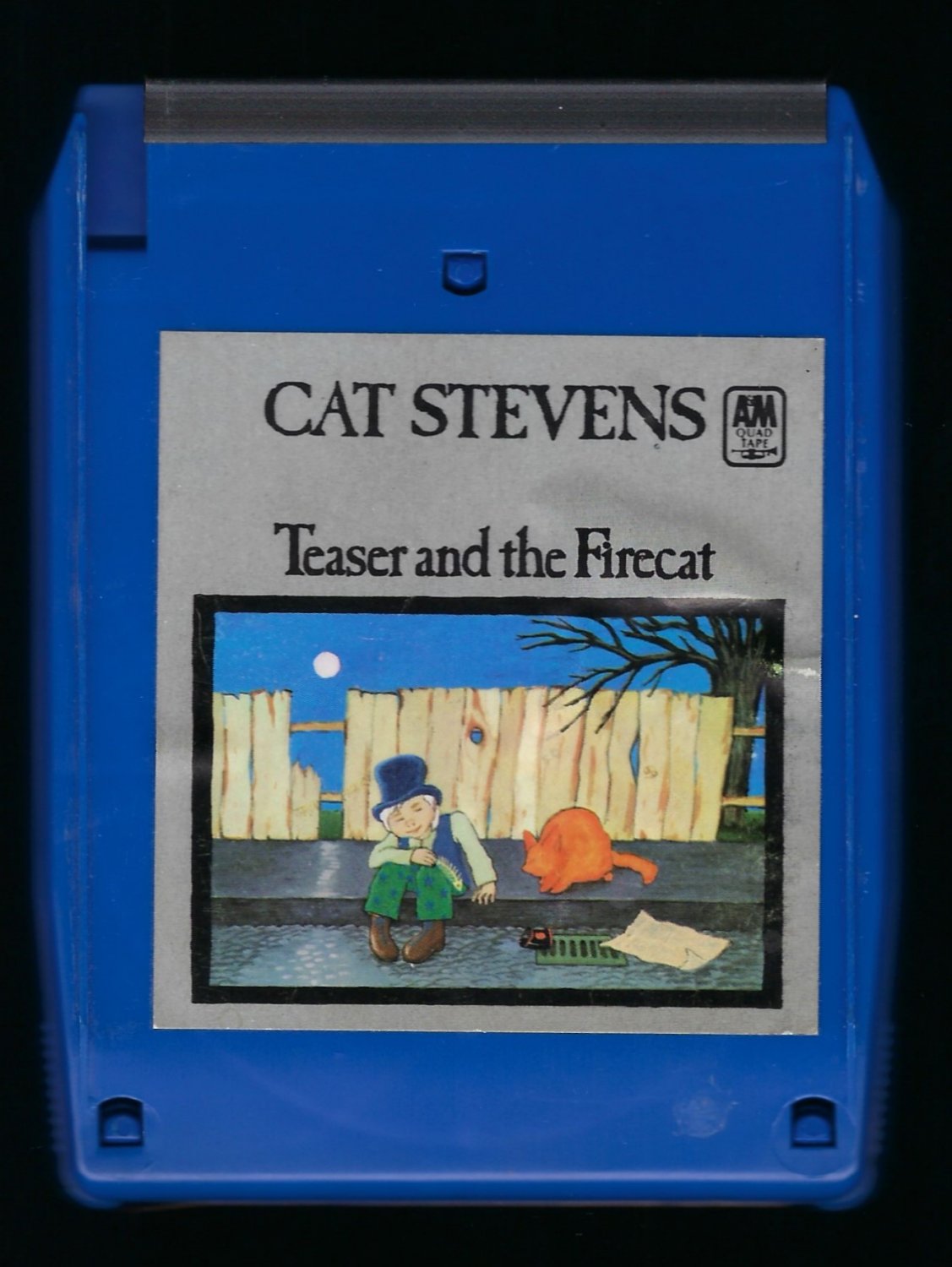


Teaser and the Firecat is the fifth studio album by Cat Stevens, released in October 1971.
At the Australian 1972 King of Pop Awards the album won Biggest Selling LP.
The album contains 10 songs, including the hits "Morning Has Broken", "Moonshadow" and "Peace Train". It is also the title of a children's book written and illustrated by Stevens. The story features the title characters from the album cover, top-hatted young Teaser and his pet, Firecat, who attempt to put the moon back in its place after it falls from the sky. Published in 1972, the book has been out of print since the mid-1970s.
The album was a commercial success, surpassing the heights achieved by Stevens' previous album, Tea for the Tillerman, reaching both the UK and US top 3 and also spending fifteen weeks at the top of the Australian charts, becoming the biggest-selling album of the country in 1972.
In 1977 an animated version, narrated by comedian Spike Milligan, using the song "Moonshadow", was a segment in Fantastic Animation Festival. In November 2008, a "deluxe edition" was released featuring a second disc of demos and live recordings.
English keyboardist Rick Wakeman played piano on "Morning Has Broken" and English musician Linda Lewis contributed vocals on "How Can I Tell You".
Yusuf Islam (born Steven Demetre Georgiou; 21 July 1948 in London, England), commonly known by his former stage name Cat Stevens, is a British musician. He is a singer-songwriter, multi-instrumentalist, educator, philanthropist, and prominent convert to Islam.
His early 1970s record albums Tea for the Tillerman and Teaser and the Firecat were both certified as Triple Platinum by the RIAA in the United States; his 1972 album Catch Bull at Four sold half a million copies in the first two weeks of release alone and was Billboard's number-one LP for three consecutive weeks. He has also earned two ASCAP songwriting awards in consecutive years for "The First Cut Is the Deepest", which has been a hit single for four different artists.
Stevens converted to Islam at the height of his fame, in December 1977, and adopted his Muslim name, Yusuf Islam, the following year. In 1979, he auctioned all his guitars away for charity and left his music career to devote himself to educational and philanthropic causes in the Muslim community. He has been given several awards for his work in promoting peace in the world, including 2003's World Award, the 2004 Man for Peace Award, and the 2007 Mediterranean Prize for Peace. In 2006, he returned to pop music with his first album of new pop songs in 28 years, entitled An Other Cup. He now goes professionally by the single name Yusuf. His newest album, Roadsinger, was released on 5 May 2009.
Retrieved from
http://en.wikipedia.org/wiki/Cat_Stevens
T21
Comes to you fully restored, ready to play with a 7-day money back guarantee.
At the Australian 1972 King of Pop Awards the album won Biggest Selling LP.
The album contains 10 songs, including the hits "Morning Has Broken", "Moonshadow" and "Peace Train". It is also the title of a children's book written and illustrated by Stevens. The story features the title characters from the album cover, top-hatted young Teaser and his pet, Firecat, who attempt to put the moon back in its place after it falls from the sky. Published in 1972, the book has been out of print since the mid-1970s.
The album was a commercial success, surpassing the heights achieved by Stevens' previous album, Tea for the Tillerman, reaching both the UK and US top 3 and also spending fifteen weeks at the top of the Australian charts, becoming the biggest-selling album of the country in 1972.
In 1977 an animated version, narrated by comedian Spike Milligan, using the song "Moonshadow", was a segment in Fantastic Animation Festival. In November 2008, a "deluxe edition" was released featuring a second disc of demos and live recordings.
English keyboardist Rick Wakeman played piano on "Morning Has Broken" and English musician Linda Lewis contributed vocals on "How Can I Tell You".
Yusuf Islam (born Steven Demetre Georgiou; 21 July 1948 in London, England), commonly known by his former stage name Cat Stevens, is a British musician. He is a singer-songwriter, multi-instrumentalist, educator, philanthropist, and prominent convert to Islam.
His early 1970s record albums Tea for the Tillerman and Teaser and the Firecat were both certified as Triple Platinum by the RIAA in the United States; his 1972 album Catch Bull at Four sold half a million copies in the first two weeks of release alone and was Billboard's number-one LP for three consecutive weeks. He has also earned two ASCAP songwriting awards in consecutive years for "The First Cut Is the Deepest", which has been a hit single for four different artists.
Stevens converted to Islam at the height of his fame, in December 1977, and adopted his Muslim name, Yusuf Islam, the following year. In 1979, he auctioned all his guitars away for charity and left his music career to devote himself to educational and philanthropic causes in the Muslim community. He has been given several awards for his work in promoting peace in the world, including 2003's World Award, the 2004 Man for Peace Award, and the 2007 Mediterranean Prize for Peace. In 2006, he returned to pop music with his first album of new pop songs in 28 years, entitled An Other Cup. He now goes professionally by the single name Yusuf. His newest album, Roadsinger, was released on 5 May 2009.
Retrieved from
http://en.wikipedia.org/wiki/Cat_Stevens
T21
Comes to you fully restored, ready to play with a 7-day money back guarantee.


