
£32.35
Add to Cart
Georges de La Tour The Repentant Magdalene Framed Print
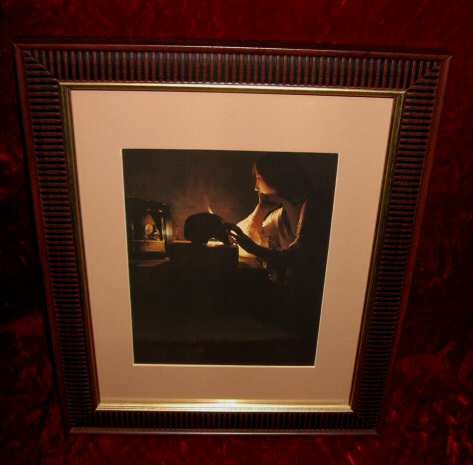


Up for sale is a marvelous Georges de La Tour framed print titled "The Repentant Magdalene". It measures approx 14"x17" in overall dimension and 7.5"x9.5" in printed area. The print is matted, framed and glassed & in excellent condition. Originally purchased at the National Gallery of Art in Washington DC. Great addition to your collections! Thanks!
Mary Magdalen was an example of the repentant sinner and consequently a symbol of the Sacrament of Penance. According to legend, Mary led a dissolute life until her sister Martha persuaded her to listen to Jesus Christ. She became one of Christ's most devoted followers and he absolved her of her former sins.
In Georges de La Tour's somber canvas Mary (circa 1635-1640) is shown in profile seated at a table. A candle is the source of light in the composition, but the light also carries a spiritual meaning as it casts a golden glow on the saint's face and the objects assembled on the table. The candle light silhouettes Mary's left hand which rests on a skull that is placed on a book. The skull is reflected in a mirror. The skull and mirror are emblems of vanitas, implying the transience of life.
Georges de La Tour (French. 1593 - 1652), is also known as Claude du Menil de La Tour; Georges de Latour; Georges du Mesnil de La Tour
Mary Magdalen was an example of the repentant sinner and consequently a symbol of the Sacrament of Penance. According to legend, Mary led a dissolute life until her sister Martha persuaded her to listen to Jesus Christ. She became one of Christ's most devoted followers and he absolved her of her former sins.
In Georges de La Tour's somber canvas Mary (circa 1635-1640) is shown in profile seated at a table. A candle is the source of light in the composition, but the light also carries a spiritual meaning as it casts a golden glow on the saint's face and the objects assembled on the table. The candle light silhouettes Mary's left hand which rests on a skull that is placed on a book. The skull is reflected in a mirror. The skull and mirror are emblems of vanitas, implying the transience of life.
Georges de La Tour (French. 1593 - 1652), is also known as Claude du Menil de La Tour; Georges de Latour; Georges du Mesnil de La Tour


