
£7.50
Add to Cart
Mao Tse-Tung on Guerilla Warfare by Samuel Griffith ➤ Praeger 1961 Book Club Edition
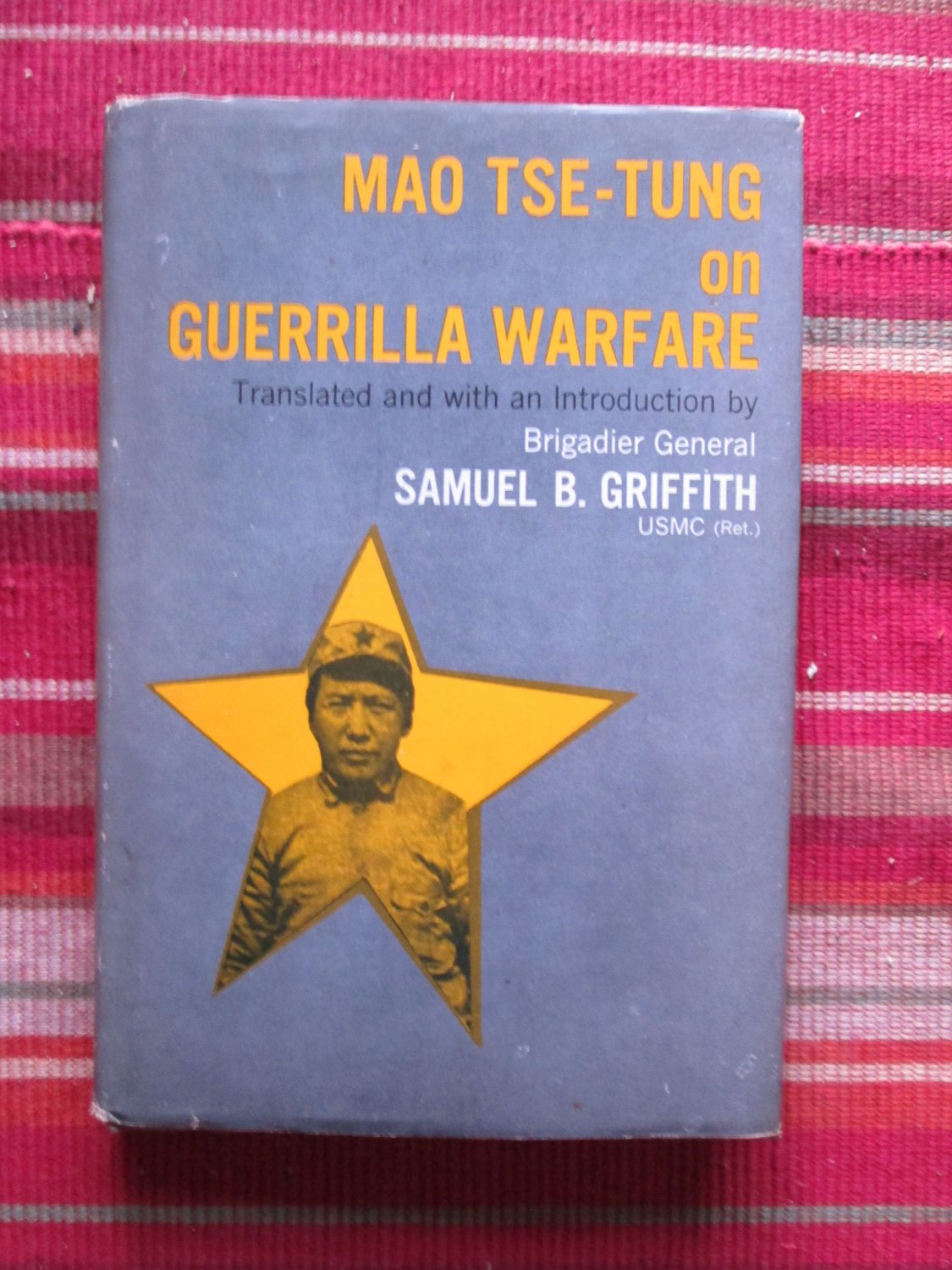


Mao Tse-Tung on Guerilla Warfare by Samuel Griffith Praeger 1961 Book Club Edition
Title: Mao Tse-Tung on Guerilla Warfare
Author: Samuel Griffith
Format: Hardcover
Publisher: Praeger 1961
Edition: Book Club Edition
Size: 5.75 X 8.5 * 114 pages plus Appendix
Synopsis: From the Jacket: In 1937, Mao Tse-tung, in retreat after ten years of battling the Nationalist troops of Chiang Kai-shek, wrote a succinct pamphlet that has become one of the most influential documents of our time. This treatise, the first systematic analysis of guerrilla warfare, established Mao as the architect of a new method of warfare.
Within the last two decades, Mao's study has become the basic textbook for waging Communist revolutionary warfare in underdeveloped and emergent areas throughout the world. It provided the strategy for Ho Chi Minh's protracted campaigns in Indochina and for Castro's successfu! Cuban revolution.
The widespread applicability of Mao's doctrine stems from his realization of the fundamental disparity between the agrarian, peasant-based society of China and that of pre-Revolutionary Russia, or any urban society. In his brilliant Introduction, Brigadier General Samuel B. Griffith traces Mao's growing conviction that to make a revolution in China, he had to employ tactics and appeals appropriate to the peasant. Further, Mao saw that the problems of terrain and supply in China required solutions on their own terms. Before and during the Long March-in fact an almost disastrous 6,000-mile retreat- Mao's theories of revolutionary guerrilla warfare were put to the test under exacting conditions, and their validity proved.
The Long March itself represented an element of strategy peculiarly suited to guerrilla warfare-the paradoxical offensive move of "running away." Other unorthodox concepts developed by Mao were: the premium placed on intelligence -readily provided by the sympathetic peasant population; the substitution of deception, mobility, and surprise for more orthodox tactics; and, perhaps the most original element of all, the emphasis on educating the inhabitants to the ideological basis of the struggle in which they were to be enlisted. It is this last element-the organized effort to establish a broad base of popular support-that has been most widely adopted by other revolutionary- warfare leaders throughout the world.
With the mounting awareness in the Western world of the radical change in the nature of warfare has come recognition of the need to understand and devise means to counter this new warfare- waged in jungles and mountains by mobile guerrilla bands closely supported by local inhabitants. According to the testimony of guerrilla leaders themselves, the prime source is MAO TSE-TUNG ON GUERRILLA WARFARE-here widely available for the first time in General Griffith's classic translation. His comprehensive Introduction contains a profile of Mao, an analysis of the nature and conduct of revolutionary guerrilla warfare, and observations on the implications for American policy.
THE AUTHOR: General Griffith served for more than twenty-five years in the Marine Corps. He was Commanding Officer of the Marine Corps First Raiders on Guadalcanal and in the New Georgia campaign. During his Marine Corps career, he was stationed in many quarters of the world, including China, Nicaragua, Cuba, France, Germany, and England. He was awarded the Navy Cross and the U.S. Army Distinguished Service Cross. A frequent contributor to both military and general magazines, General Griffith holds a Ph.D. in Chinese history from Oxford.
Overall Condition: Very good: The book does not look new and has been read but is in excellent condition. There is no obvious damage to the cover the dust jacket (with minor wear and tear) is included. There are no missing or damaged pages, no creases or tears, and no underlining/highlighting of text or writing in the margins. It may have very minimal identifying marks on the inside cover as well as very minimal wear and tear. See images.
Secure shipping bubble-wrapped in a new box/mailer.
2026--U.S. shipping for this (One Pound Media Mail) is $4.39 with tracking.
Multiple items will be combined for the lowest shipping price.
International Shipping cost is based on the destination so inquire before buying. Mobile users must scroll to the bottom and click on 'use desktop site' to bring up the Ask a Question link which sends me an email.
(PLEASE CONTACT ME BEFORE MAKING ANY PAYMENT FROM OUTSIDE THE U.S.)
==========================================================================================================================
Just about all the books are USED books. Some have been used more gently than others. Some have been in libraries and have typical library extras. Some are so old and/or interesting that they are being offered for the sake of preservation regardless of the condition they are in. If the condition of the book is very important to you, please feel free to click the 'Ask seller a question' link and I will tell you more.
=========================================================================================
Title: Mao Tse-Tung on Guerilla Warfare
Author: Samuel Griffith
Format: Hardcover
Publisher: Praeger 1961
Edition: Book Club Edition
Size: 5.75 X 8.5 * 114 pages plus Appendix
Synopsis: From the Jacket: In 1937, Mao Tse-tung, in retreat after ten years of battling the Nationalist troops of Chiang Kai-shek, wrote a succinct pamphlet that has become one of the most influential documents of our time. This treatise, the first systematic analysis of guerrilla warfare, established Mao as the architect of a new method of warfare.
Within the last two decades, Mao's study has become the basic textbook for waging Communist revolutionary warfare in underdeveloped and emergent areas throughout the world. It provided the strategy for Ho Chi Minh's protracted campaigns in Indochina and for Castro's successfu! Cuban revolution.
The widespread applicability of Mao's doctrine stems from his realization of the fundamental disparity between the agrarian, peasant-based society of China and that of pre-Revolutionary Russia, or any urban society. In his brilliant Introduction, Brigadier General Samuel B. Griffith traces Mao's growing conviction that to make a revolution in China, he had to employ tactics and appeals appropriate to the peasant. Further, Mao saw that the problems of terrain and supply in China required solutions on their own terms. Before and during the Long March-in fact an almost disastrous 6,000-mile retreat- Mao's theories of revolutionary guerrilla warfare were put to the test under exacting conditions, and their validity proved.
The Long March itself represented an element of strategy peculiarly suited to guerrilla warfare-the paradoxical offensive move of "running away." Other unorthodox concepts developed by Mao were: the premium placed on intelligence -readily provided by the sympathetic peasant population; the substitution of deception, mobility, and surprise for more orthodox tactics; and, perhaps the most original element of all, the emphasis on educating the inhabitants to the ideological basis of the struggle in which they were to be enlisted. It is this last element-the organized effort to establish a broad base of popular support-that has been most widely adopted by other revolutionary- warfare leaders throughout the world.
With the mounting awareness in the Western world of the radical change in the nature of warfare has come recognition of the need to understand and devise means to counter this new warfare- waged in jungles and mountains by mobile guerrilla bands closely supported by local inhabitants. According to the testimony of guerrilla leaders themselves, the prime source is MAO TSE-TUNG ON GUERRILLA WARFARE-here widely available for the first time in General Griffith's classic translation. His comprehensive Introduction contains a profile of Mao, an analysis of the nature and conduct of revolutionary guerrilla warfare, and observations on the implications for American policy.
THE AUTHOR: General Griffith served for more than twenty-five years in the Marine Corps. He was Commanding Officer of the Marine Corps First Raiders on Guadalcanal and in the New Georgia campaign. During his Marine Corps career, he was stationed in many quarters of the world, including China, Nicaragua, Cuba, France, Germany, and England. He was awarded the Navy Cross and the U.S. Army Distinguished Service Cross. A frequent contributor to both military and general magazines, General Griffith holds a Ph.D. in Chinese history from Oxford.
Overall Condition: Very good: The book does not look new and has been read but is in excellent condition. There is no obvious damage to the cover the dust jacket (with minor wear and tear) is included. There are no missing or damaged pages, no creases or tears, and no underlining/highlighting of text or writing in the margins. It may have very minimal identifying marks on the inside cover as well as very minimal wear and tear. See images.
Secure shipping bubble-wrapped in a new box/mailer.
2026--U.S. shipping for this (One Pound Media Mail) is $4.39 with tracking.
Multiple items will be combined for the lowest shipping price.
International Shipping cost is based on the destination so inquire before buying. Mobile users must scroll to the bottom and click on 'use desktop site' to bring up the Ask a Question link which sends me an email.
(PLEASE CONTACT ME BEFORE MAKING ANY PAYMENT FROM OUTSIDE THE U.S.)
==========================================================================================================================
Just about all the books are USED books. Some have been used more gently than others. Some have been in libraries and have typical library extras. Some are so old and/or interesting that they are being offered for the sake of preservation regardless of the condition they are in. If the condition of the book is very important to you, please feel free to click the 'Ask seller a question' link and I will tell you more.
=========================================================================================


